Showing posts with label holidays and festivals. Show all posts

Tuesday, January 09, 2007

Coming of Age Day

Yesterday, as I went out to buy some groceries, I saw many girls clad in their elegant and seemingly heavy kimono, scattered around the park, waiting for something. Then I learned from a friend that yesterday was the Coming of Age Day, or Seijin no Hi.

This day, as Japan Guide puts it,

The Coming of Age festival is celebrated on the second Monday of January (it used to be celebrated always on January 15 until the year 1999). Its Japanese name is Seijin no hi. All young people who turn twenty years old in that year are celebrated on Seijin no hi. Twenty is the age considered as the beginning of adulthood. It is also the minimum legal age for voting, drinking, and smoking.

Celebrations are held nationwide in every town with most of the people turning 20 participating in formal dresses. Seijin no hi is a national holiday.
Quite surprising for me to learn that the kimono these young adults wear are so expensive one could already buy a standard car (according to my friend). Renting is the only option, which means spending about 200,000yen for wearing a complete set of kimono for ONE DAY.

But more than the elegant attire is the spirit with which this day is held -- to become adults not only in terms of age, but more importantly, to THINK, ACT and BEHAVE as ADULTS should.

Read more about Coming of Age here (written in 1998).

Image source: dougcoutts.com

Wednesday, October 11, 2006

Visit to Shinjuku Gyoen

pink flower of water lilyAmong others, Japan is known for its neat and wide parks across the nation. In Tokyo alone, you would find at least a small yet cozy park in almost every corner, where you can briefly take a rest from a long walk. And many, including myself, would (initially) wonder why this modern society takes a big step at keeping huge parks despite its nation's relatively small land area. I guess, one would have to personally experience the peace and calmness that these places give to their visitors, like us.

Last Monday, since it was a holiday (Health and Sports Day, Taikuu no Hi) and the weather was terrribly good, we booked ourselves to breathe through the greens and cool breeze in Shinjuku Gyoen National Garden, right at the heart of Tokyo. What more, a Jap friend of ours who works in the Garden, paid for our entrance fees. ;)

The place itself is wide and well-maintained, giving visitors the valued time to appreciate and commune with nature -- in the midst of the hustle-and bustle megacity of Tokyo. It is a classic example of a modern western landscape garden, and thus having the stature as one of the most important gardens of the Meiji era.

The large garden exhibits three distinct but blending styles of landscape:

English Landscape Garden: A wide lawn, dotted with zelvoka, tulip poplars and other large trees that create a sense of openness in this garden.

French Formal Garden: This beautifully symmetrical garden features central rose beds flanked on either side by rows of sycamore trees.

Japanese Traditional Garden: A stream winds its way through this circuit style garden. It also includes Kyu-Goryo-Tei (also known as the Taiwan Pavilion) and two teahouses known as the Shouten-tei and Rakuu-tei.
The Garden boasts of its luxurious sights throughout the year. It was all fresh green when we went there -- the awesome color of summer. At this time,
The trees turn a lustrous shade of green, and refreshingly cool breezes blow through the woods. The roses in the French Formal Garden and in front of the Greenhouse bloom in early summer, and the water lilies of the Middle Pond draw visitors with their white and pink flowers. In high summer, the songs of hte cicadas swell into a lively chorus, and dragonflies laze over the wide lawns.
Soon, the colorful autumn leaves will decorate the whole place. And yes, we'll visit this place again to witness the gold-yellow-orange-red colors of autumn, most especially the annual "Chrysanthemum Exhibition associated with the Imperial Household" slated on November 1-15.

Click here for more photos.

Enjoy nature at its best! ;)

Friday, July 14, 2006

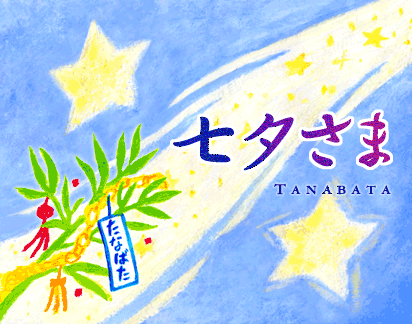
Tanabata "Star" Festival

by Yoko Shibata
In Japan, Tanabata is celebrated every July 7th (or August 7th in some areas) where it is believed that at this time of the year, loverstars Altair and Vega get to meet each other.

During this Star Festival, children usually write their wishes on a white piece of paper (with a star pasted on it) and hang them in a bamboo branch (with some decorations too), and place the whole bunch near the window or door of the house, so that when the Stars see them, they will grant the children's wishes.

I did this for Luke. I made several wishes for him, mostly about his health and overall development, with high hopes that the Stars would pass by our house and read the wishes. ;) Coincidentally, Luke got feverish the day after Tanabata. But this doesn't mean that Tanabata is not true. I don't discourage anyone from believing or making the wishes. As I said, it was just coincidental.

More facts about Tanabata can be found at: Japan-Guide and Kids Web Japan
Photo taken from Kids Web Japan, ©Yoko Shibata

Saturday, April 29, 2006

Greenery Day and Golden Week

Today, April 29th, is Japan's Greenery Day (Midori-no-hi), a holiday that marks the start of the most-awaited Golden Week. April 29th used to be the birthday of Emperor Shouwa, and following his death in 1989, this day has become a day of nature appreciation since the late emperor had a strong fascination for nature and plants. In patronage to this holiday and for self-enjoyment, we went strolling at the splendid 14-ha Ueno Zoo in downtown Tokyo. The weather wasn't cooperative, though, so we arrived home earlier than expected. Nevertheless, we enjoyed what we had seen there so far. Check out my other blog for some stories.

So, the Golden Week has finally arrived. Why golden? According to Web Japan, it was "first used by movie companies to get people to take advantage of the "golden" opportunity to go see a film. The term gradually began being used by other people to refer to this string of holidays."

Yup, string of holidays. What are these holidays, by the way? Here's a detailed description from Japan-Guide.Com:

April 29
Greenery Day (Midori no hi):
April 29 used to be the birthday of Emperor Showa, who died in the year 1989. After his death, the day was changed into a national holiday for environment and nature, since the emperor loved plants and nature. From 2007, this national holiday will be renamed Showa Day, while Greenery Day will be moved to May 4.

May 3
Constitution Day (Kenpo kinenbi):
On this day in 1947, the new post war constitution was put into effect.

May 4
"Between Day" (Kokumin no kyujitsu):
According to Japanese law, a day which falls between two national holidays is also declared a national holiday, unless the "between day" is a Sunday, in which case it will be just a regular Sunday. From 2007, Greenery Day, currently celebrated on April 29, will be moved to May 4.

May 5
Children's Day (Kodomo no hi):
The Boy's Festival (Tango no Sekku) is celebrated on this day. Families pray for the health and future success of their sons by hanging up carp streamers and displaying samurai dolls, both symbolizing strength, power and success in life. The Girl's Festival, by the way, is celebrated on March 3.

Golden Week is thus one of the busiest holiday in Japan. Especially so in this year, it will be a 10-day g-r-a-n-d vacation to many. Most people travel on this season, either around Japan or overseas (check out Japan-Guide.com's 2000 survey). As for us, we have no grand plans but we want to see some nice places around.

More about Golden Week at: Web Japan and Go Japan

Have a wonderful week everyone! ;)